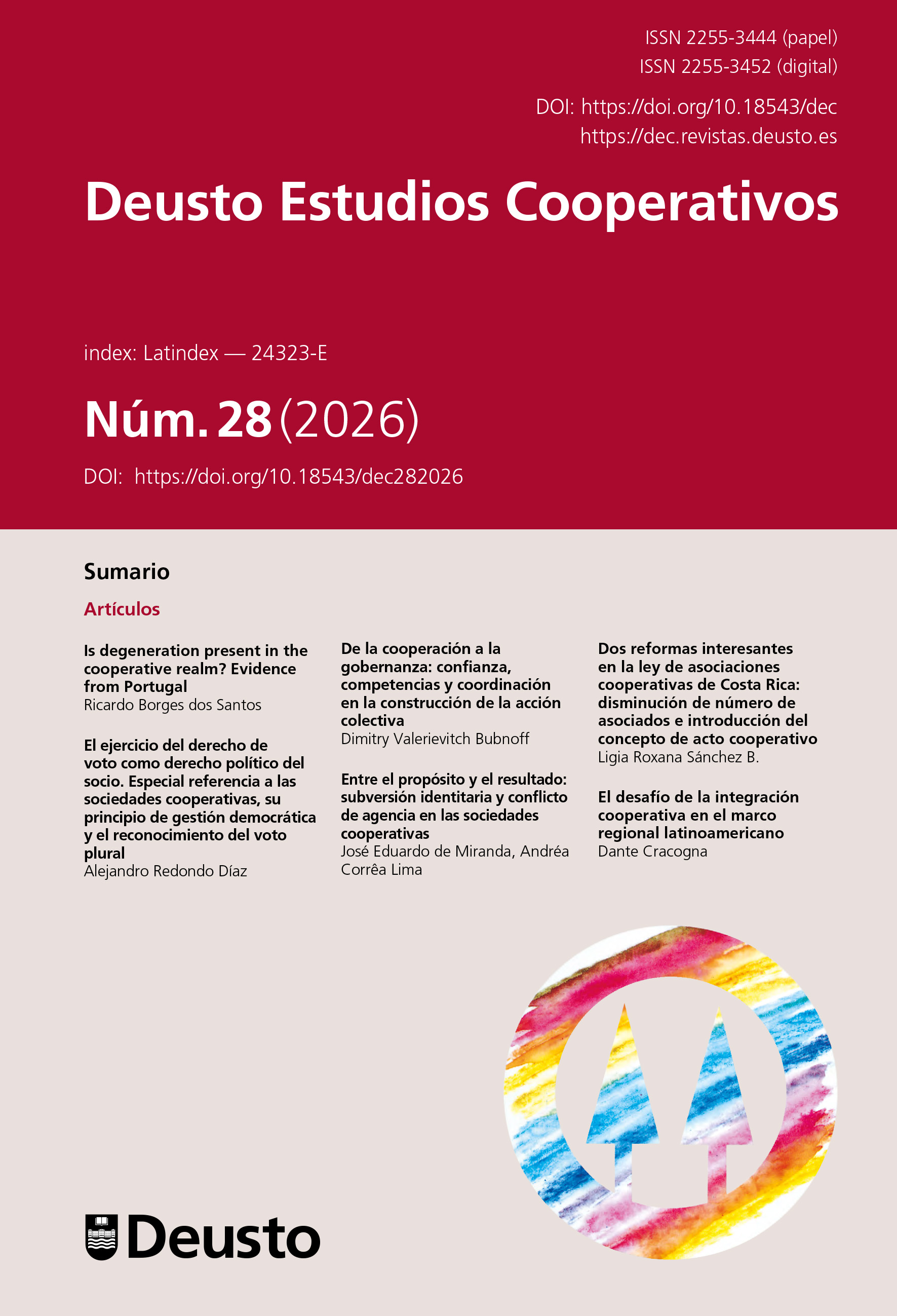
The exercise of the right to vote as a political right of the shareholder. Special mention to cooperative companies, their principle of democratic management and the recognition of plural voting
Abstract
The right to vote is considered the most relevant political right that is recognized by the shareholder due to his or her status as such. However, the differences depending on the type of company are extremely significant. While at one extreme we have corporations, governed by the plutocratic principle of the majority of social capital; on the other hand, there are cooperative societies, which due to its nature and essence, is applicable the democratic criterion of “one member, one vote”. Finally, in an intermediate term, there are limited liability companies that, being the most personal of the capital companies, are considered a hybrid type of company. However, the case that arouses the greatest legal interest may be that of cooperative societies, as it is a type of company that is not as common in commercial practice as capitalist companies, but which nevertheless allows the development of any business activity and, in addition, in a more personal, participatory and familiar way. In this regard, the peculiar thing is that the above does not apply uniformly
in all cooperative legislation, nor in all the specific cases that may arise within the framework of this type of company.
Received: 5 June 2026
Accepted: 23 June 2026
Downloads

This work is licensed under a Creative Commons Attribution-NonCommercial-NoDerivatives 4.0 International License.
Last update: 22/05/2026
For content published from Issue No. 1 (2012) through Issue No. 26 (2025), the copyright and exploitation rights belong exclusively to the journal’s publisher, in accordance with the policy in effect at the time of publication. From Issue No. 27 (2026) onwards, the following licensing terms and copyright provisions apply:
The authors are advised to read their rights carefully. We believe this approach ensures a fair agreement for both parties. These instructions should be read in conjunction with the Ethical Guidelines and the Open Access Policy, Licensing Terms and Copyright of the journal "Deusto Estudios Cooperativos (DEC)".
1. Authorship and Ethics
By submitting their manuscripts to Deusto Estudios Cooperativos (DEC), the authors accept and undertake to comply with the conditions of publication without the need to sign an additional transfer agreement with the Publisher (University of Deusto). In doing so, they guarantee that their work is unpublished in any form, original, and does not breach DEC’s Ethical Guidelines or the rights of third parties, and that no licences have been or will be granted that are incompatible with the rights granted to the Publisher.
The authors assume full and exclusive responsibility for the content of the study and formally declare that they have no conflicts of interest that affect the integrity of the research.
2. Publisher’s Rights
By submitting the manuscript, the authors agree to its publication under the Creative Commons CC BY-NC-ND 4.0 licence. Consequently, they grant the Publisher the exclusive, royalty-free and worldwide right of first publication, editing, layout and exploitation of the article. This grant authorises the Publisher to distribute, sub-license and index the work in any format, medium, database or institutional repository, for the purposes of promotion and scientific dissemination.
3. Copyright
The authors retain the intellectual property rights to their article and retain the right to distribute and use their work for teaching purposes, future research or personal archiving, provided that the original publication in the Journal is cited. They are also permitted to republish in other media, provided that a (foot)note is included with the full reference to DEC (including the DOI, where available) and no explicit endorsement of the Journal and/or Publisher is implied.
4. Open access
DEC is an open-access journal; this means that it is freely and fully accessible in its entirety immediately upon publication of its content. However, in accordance with the licence mentioned above, the authors of the articles must always be properly cited; and both commercial use and any modification intended for distribution will require the express prior written permission of the rights holder.
More details are available under the section “Open Access Policy, Licensing Terms and Copyright”.