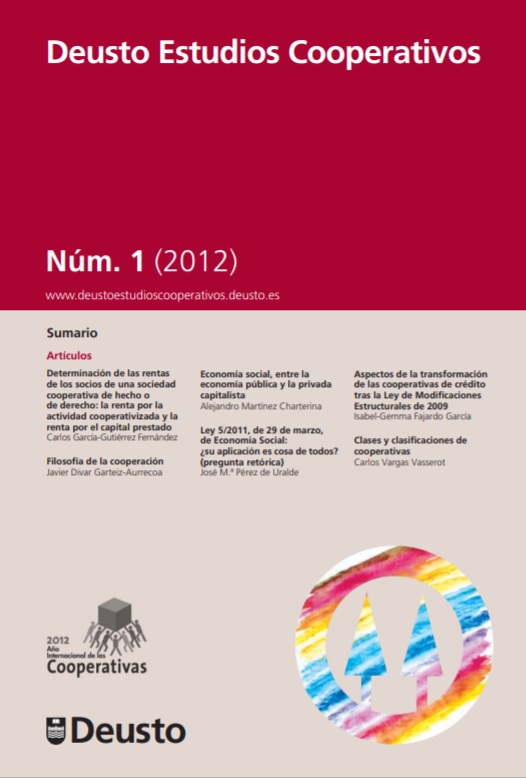
Aspectos de la transformación de las cooperativas de crédito 1tras la Ley de Modificaciones Estructurales de 2009
Abstract
Law 3/2009 on structural changes in corporations modified the law on cooperative credit unions in order to regulate certain aspects of converting these, with special focus on how mandatory reserve funds should be used in these processes and which must be included in the new entity’s share capital. This work analyses conversion as a structural modification available to cooperatives, particularly credit cooperatives; their acknowledgment by law and in Spanish jurisprudence over time; the legal problems posed, and particularly the use of mandatory reserve funds. The study concludes with a proposal for interpretation of the current article 10.2 of the Law on credit cooperatives, which makes the underlying interests of the reform compatible with cooperative values and principles.
Received: 28 July 2012
Accepted: 04 September 2012
Downloads

This work is licensed under a Creative Commons Attribution-NonCommercial-NoDerivatives 4.0 International License.
Last update: 22/05/2026
The authors are advised to read their rights carefully. We believe this approach ensures a fair agreement for both parties. These instructions should be read in conjunction with the Ethical Guidelines and the Open Access Policy, Licensing Terms and Copyright of the journal "Deusto Estudios Cooperativos (DEC)".
1. Authorship and Ethics
By submitting their manuscripts to Deusto Estudios Cooperativos (DEC), the authors accept and undertake to comply with the conditions of publication without the need to sign an additional transfer agreement with the Publisher (University of Deusto). In doing so, they guarantee that their work is unpublished in any form, original, and does not breach DEC’s Ethical Guidelines or the rights of third parties, and that no licences have been or will be granted that are incompatible with the rights granted to the Publisher.
The authors assume full and exclusive responsibility for the content of the study and formally declare that they have no conflicts of interest that affect the integrity of the research.
2. Publisher’s Rights
By submitting the manuscript, the authors agree to its publication under the Creative Commons CC BY-NC-ND 4.0 licence. Consequently, they grant the Publisher the exclusive, royalty-free and worldwide right of first publication, editing, layout and exploitation of the article. This grant authorises the Publisher to distribute, sub-license and index the work in any format, medium, database or institutional repository, for the purposes of promotion and scientific dissemination.
3. Copyright
The authors retain the intellectual property rights to their article and retain the right to distribute and use their work for teaching purposes, future research or personal archiving, provided that the original publication in the Journal is cited. They are also permitted to republish in other media, provided that a (foot)note is included with the full reference to DEC (including the DOI, where available) and no explicit endorsement of the Journal and/or Publisher is implied.
4. Open access
DEC is an open-access journal; this means that it is freely and fully accessible in its entirety immediately upon publication of its content. However, in accordance with the licence mentioned above, the authors of the articles must always be properly cited; and both commercial use and any modification intended for distribution will require the express prior written permission of the rights holder.
More details are available under the section “Open Access Policy, Licensing Terms and Copyright”.
3.jpg)
3.jpg)