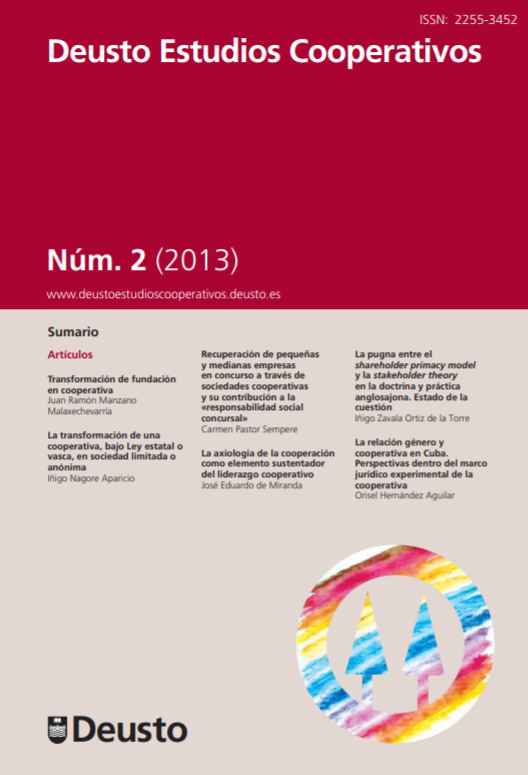
La pugna entre el shareholder primacy model y la stakeholder theory en la doctrina y práctica anglosajona. Estado de la cuestión
Abstract
There exists a struggle between the activist of the Shareholder Primacy Model, and those who support the Stakeholder Theory (in the interest of the shareholders, employees, customers, creditors and suppliers). Although the scholars and the legislations are prone to the second theory, the reality and the analysis of the Corporate Governance Codes, shows us that the former one is still in the victorious. Why?
Received: 14 January 2013
Accepted: 18 February 2013
Downloads

This work is licensed under a Creative Commons Attribution-NonCommercial-NoDerivatives 4.0 International License.
Last update: 22/05/2026
The authors are advised to read their rights carefully. We believe this approach ensures a fair agreement for both parties. These instructions should be read in conjunction with the Ethical Guidelines and the Open Access Policy, Licensing Terms and Copyright of the journal "Deusto Estudios Cooperativos (DEC)".
1. Authorship and Ethics
By submitting their manuscripts to Deusto Estudios Cooperativos (DEC), the authors accept and undertake to comply with the conditions of publication without the need to sign an additional transfer agreement with the Publisher (University of Deusto). In doing so, they guarantee that their work is unpublished in any form, original, and does not breach DEC’s Ethical Guidelines or the rights of third parties, and that no licences have been or will be granted that are incompatible with the rights granted to the Publisher.
The authors assume full and exclusive responsibility for the content of the study and formally declare that they have no conflicts of interest that affect the integrity of the research.
2. Publisher’s Rights
By submitting the manuscript, the authors agree to its publication under the Creative Commons CC BY-NC-ND 4.0 licence. Consequently, they grant the Publisher the exclusive, royalty-free and worldwide right of first publication, editing, layout and exploitation of the article. This grant authorises the Publisher to distribute, sub-license and index the work in any format, medium, database or institutional repository, for the purposes of promotion and scientific dissemination.
3. Copyright
The authors retain the intellectual property rights to their article and retain the right to distribute and use their work for teaching purposes, future research or personal archiving, provided that the original publication in the Journal is cited. They are also permitted to republish in other media, provided that a (foot)note is included with the full reference to DEC (including the DOI, where available) and no explicit endorsement of the Journal and/or Publisher is implied.
4. Open access
DEC is an open-access journal; this means that it is freely and fully accessible in its entirety immediately upon publication of its content. However, in accordance with the licence mentioned above, the authors of the articles must always be properly cited; and both commercial use and any modification intended for distribution will require the express prior written permission of the rights holder.
More details are available under the section “Open Access Policy, Licensing Terms and Copyright”.
3.jpg)
3.jpg)